Reliability Engineering Handbook, Volume 2

For many kinds of equipment, especially missiles and space systems, only success and failure attribute data are obtained to analyze the trend of reliability growth. Methods are given in this section to handle such data.
METHOD 1
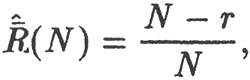
Conservatively, the cumulative reliability can be used to estimate the trend of reliability growth. The cumulative reliability is given by
| (16.10) | |
where
| N | = | current number of trials, |
and
| T | = | number of failures. |
It must be emphasized that the instantaneous reliability of the developed equipment is increasing as the test-analyze-fix-and-test process continues, and the instantaneous reliability is higher than the cumulative reliability. Therefore, the reliability growth curve based on the cumulative reliability can be thought of as the lower bound of the true reliability growth curve.
Q:
In an aerospace program the launch vehicle was successful in 15 out of the 22 launches. The specific success and failure launch data are given in Table 16.4. Do the following based on the cumulative reliability:
Find the Gompertz reliability growth curve using the results of the first 15 launches.
Find the reliability after Launch 22 as predicted by this curve.
Compare the reliability found in Case 2 and in Table 16.5 after Launch 22.
Table 16.4: Missile launch data for Example 16 3. Launch number
Success
Failure
Cumlative reliability estimate,
%
1
X
0.0
2
X
0.0
4
X
25.0
5
X
20.0
6
X
16.7
7
X