Robotics: The Algorithmic Perspective

Several groups have described efforts to apply MEMS (micro electro mechanical system) actuators to positioning, inspection, and assembly tasks with small parts [50, 3, 37, 24, 45, for example]. However, the fabrication, control, and programming of micro-devices that can interact and actively change their environment remains challenging. Problems arise from
the limited range of motion and force that can be generated with microactuators,
the lack of sufficient sensor information with regard to manipulation tasks,
design limitations and geometric tolerances due to the fabrication process, and
uncertain material properties and the lack of adequate models for mechanisms at very small scales.
In the following subsections we describe two different types of actuator arrays: single-crystal silicon (SCS) electrostatic actuators, and combined thermobimorph and electrostatic organic micro cilia.
We now survey recent work on single-crystal silicon electrostatic MEMS actuators, conducted in collaboration with Noel MacDonald at the Cornell Nanofabrication facility [18, 18, 19, 20, 24, 23].
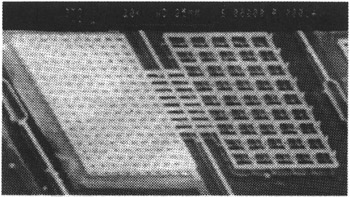
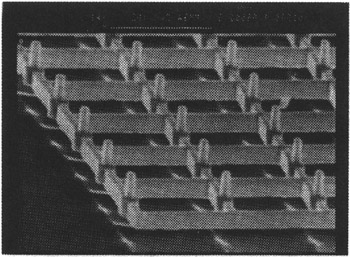
The M-Chip ( Manipulation Chip, see Figure 3) is fabricated using a Scream ( Single- Crystal Silicon Reactive Etching and Metallization)...