Robotics: The Algorithmic Perspective

We now survey some basic concepts of actuator gaits using MEMS arrays for massively parallel microanipulation, developed in collaboration with Jonathan Suh and Greg Kovacs at the Stanford University National Nanofabrication facility [21, 26].
To induce motion on a part that is placed on the array, the cilia are actuated in a cyclic, gait-like fashion. In each cycle, the part is moved in a certain direction by the motion of the actuators that are in contact with it. The speed of the moving part depends on the (horizontal) displacement of the actuators per cycle as well as the frequency of cycle repetition. It also depends on the surface properties and weight of the moving part.
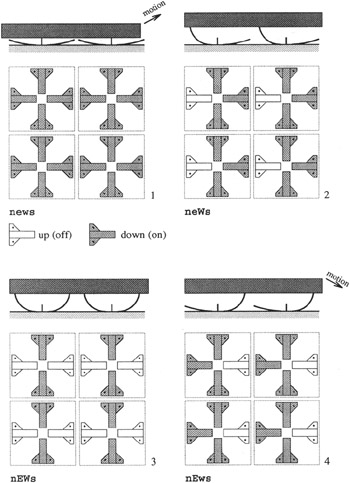
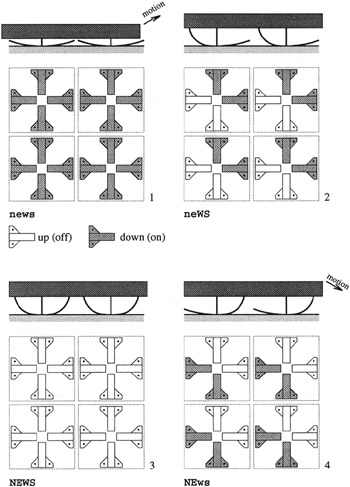
Task: translation of parts in principal directions. The simplest gait is the two-phase gait, in which all actuators of the same orientation repeatedly stroke the part while the remaining actuators are held down. Assuming that the orthogonal cilia within a motion pixel are oriented at the principal compass points, let us use capital letters NEWS to denote the North, East, West, and South actuators in the up position, and lower-case letters news to denote the actuators in the lowered position. Then the two-phase gait to effect motion in the East direction would be news neWs (see Figure 10).