Richard M. Murray, Joel W. Burdick, Scott D. Kelly, James Radford California Institute of Technology, Pasadena, CA, USA
This paper gives a survey of current and emerging techniques for motion control of nonlinear mechanical systems, motivated by applications in robotic locomotion. For this class of systems, internal changes of shape and/or application of body fixed forces are the mechanism by which the robot moves in its environment and the geometric mechanical properties of the system are crucial in understanding how specific gaits for generating motion can be obtained.
1 Introduction
We define a robotic locomotion system as a robotic device that is capable of propelling itself in its environment. A typical example of a locomotion system is a wheeled mobile robot, such as the Hilare mobile robot depicted in Figure 1. This system interacts with its environment through the constraints imposed by the wheels touching the ground. Under normal operation, the wheels roll without slipping, allowing the robot to apply forces against its environment and propel itself.
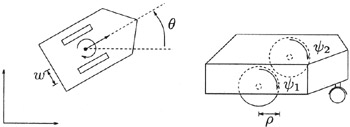 Figure 1: The Hilare mobile robot.
 The interaction of a mobile robot with its environment is clearly essential in order for the robot to locomote. It turns out that in a variety of instances, this interaction can be modelled as a Pfaffian constraint of the form
| (1) | 
|
where q is the configuration of the robot and k is the number of constraints between the robot and its environment. This is precisely the type of constraint that arises...
Copyright A K Peters, Ltd. 1998 under license agreement with Books24x7

 TABLE OF CONTENTS