Robotics: The Algorithmic Perspective

Joe Warren, Department of Computer Science, Rice University
Subdivision is an iterative process that maps an initial coarse shape into finer and finer shapes. If the subdivision process is carefully chosen, then the limit of this process is a smooth, curved shape that roughly follows the initial coarse shape. Due to this correlation, subdivision has proven to be an increasingly popular method for representing curved shape. This paper first reviews two related modeling techniques: functions and fractals. The paper then gives a brief introduction to subdivision viewed as a fusion of these two techniques.
Geometric modeling examines the fundamental problem: What is a good representation for complicated, curved shape? Although there are many different approaches, most methods fall into one of two categories: functions or fractals.
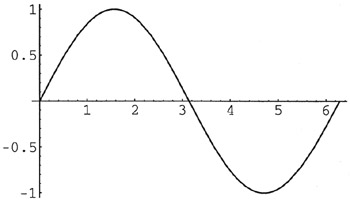
Functions map a parameter t to a function value F( t). Plotting the graph of a smooth function F over finite range defines a shape,
In figure 1, the function sin( t) defines a wave-like shape.
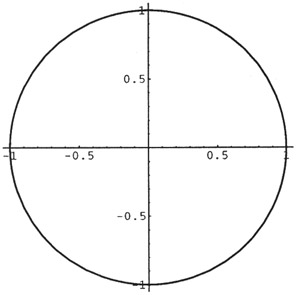
A pair of functions can be combined to define a shape parametrically.
For example in figure 2, the parameterization ( cos( t), sin( t)) defines a circle. Alternatively, a curve can be defined implicitly as the zero contour of a bivariate variate function F,
For example, a circle...