RSM Simplified: Optimizing Processes using Response Surface Methods for Design of Experiments

"Theory guides, experiment decides."
I. M. KOLTHOFF (UNIVERSITY OF MINNESOTA PROFESSOR KNOWN AS THE FATHER OF ANALYTICAL CHEMISTRY)
From the very beginning (Box and Wilson, 1951), statisticians have debated criteria for the ideal structure of the central composite design (CCD), in particular the number of center points per block and how far out the axial levels (star points) should go. In this chapter we will discuss what's good in theory versus more practical considerations for real-life experimentation.
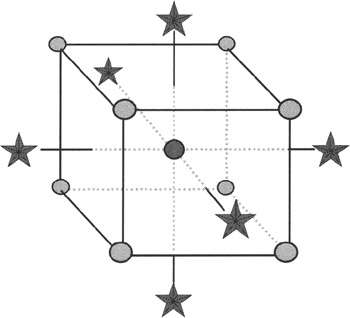
Let's start by tackling the toughest issue for experimenters wanting to do RSM via CCDs where to place their star points. For over half a century the dogma has been that stars must go outside of the factorial box, as shown in Figure 8-1.
Going to these extremes offers advantages, the most obvious of which is the greater leverage for estimating main effects and curvature. The main disadvantage of venturing outside the box is equally obvious the stars may break the envelope of what's safe or even physically possible. For example, what if you include a factor such as a dimension of a physical part and the lower star point comes out negative? Or, worse yet, the equipment may fail catastrophically when certain operating limits are exceeded at the upper star points. There's a more subtle disadvantage to the standard construction for the CCD; experimenters often find it inconvenient to adjust their process to the five levels required of each factor:
Low axial...