RSM Simplified: Optimizing Processes using Response Surface Methods for Design of Experiments

Going Cuboidal When Your Region of Operability and Interest Coincide

Here is a communication (Anderson, 2001) with an actual experimenter that raises some practical questions about where to place star points in a central composite design:

"I am having a tough time trying to decide between two CCDs, one with alpha of 1.682 [rotatable] and the other with alpha of 1 [face-centered]. I have three factors, each of which can vary from 0 to 100. Negative values are inadmissible. Therefore, I generated the first [rotatable] design by setting factor ranges in terms of alpha."

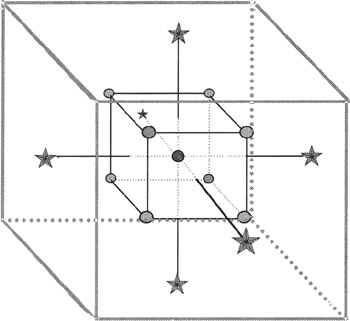
In this case, the experimenter's region of operability (0 to 100) and region of interest coincide. Imagine trying to force-fit the rotatable three-factor CCD (coded alpha = 1.682) into a cubical cage with sides each 100 actual units in length. The factorial cube is now pushed well within the middle of the region of interest (see Figure 8-5).


Figure 8-5: Rotatable CCD fit into cubical region of operability

Clearly, only a minor portion of the region of operation/interest will be explored by the RSM design, specifically (1/1.682) 3 or 0.21. In other words, nearly 80 percent of the region of interest is left relatively unexplored.

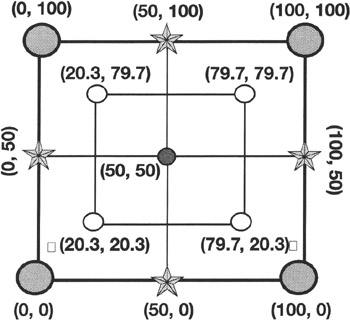
Now we see that the experimenter's idea of doing a face-centered central composite design (FCD) makes much more sense. By looking at a two-factor projection of the 3D region, Figure 8-6 provides a comparative view of the FCD versus CCD inscribed within the operating limits of 0 to 100.


Figure...

UNLIMITED FREE
ACCESS
TO THE WORLD'S BEST IDEAS

SUBMIT
Already a GlobalSpec user? Log in.

This is embarrasing...

An error occurred while processing the form. Please try again in a few minutes.

Customize Your GlobalSpec Experience

Category: Diodes
Finish!
Privacy Policy

This is embarrasing...

An error occurred while processing the form. Please try again in a few minutes.