RSM Simplified: Optimizing Processes using Response Surface Methods for Design of Experiments

So now you know a lot more about the construction of central composite designs than you ever wanted to learn. Unless you are a statistician (who laps this kind of stuff up), it's likely that at this stage you suffer from TMI (too much information!). Therefore, we decided it would be merciful to try summarizing our recommendations on CCDs.
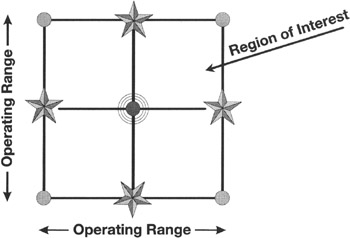
First of all you must consider how your region of interest relates to the operating boundaries for the experimental factors. For example, consider the situation pictured in Figure 8-11.
It depicts an FCD (equivalent in this case to a full three-level design) for two factors held within operating limits. The circles around the center point show that it's replicated a number of times we recommend five for a good test on lack of fit. In cases such as this, where the regions of interest and operation coincide, we recommend the FCD.
On the other hand, when operating limits do not come into play relative to the factor ranges you wish to explore; in other words, you will not be pressing against the process envelope, the more traditional form of CCD, with stars outside the box, will provide much improved predictive properties. However, to keep the range of these wayward stars within realistic striking distance, we recommend setting them at the fourth root of the number of factors ( ? = k 1/4). At this setting of...