Schaum's Outline of Theory and Problems of Digital Signal Processing
The Fourier representation of signals plays an extremely important role in both continuous-time and discrete-time signal processing. It provides a method for mapping signals into another "domain" in which to manipulate them. What makes the Fourier representation particularly useful is the property that the convolution operation is mapped to multiplication. In addition, the Fourier transform provides a different way to interpret signals and systems. In this chapter we will develop the discrete-time Fourier transform (i.e., a Fourier transform for discrete-time signals). We will show how complex exponentials are eigenfunctions of linear shift-invariant (LSI) systems and how this property leads to the notion of a frequency response representation of LSI systems. Finally, we will explore how the discrete-time Fourier transform may be used to solve linear constant-coefficient difference equations and perform convolutions.
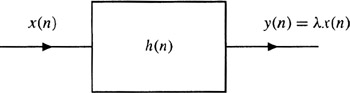
Eigenfunctions of linear shift-invariant systems are sequences that, when input to the system, pass through with only a change in (complex) amplitude. That is to say, if the input is x( n), the output is y( n) = ? x( n), where ?, the eigenvalue, generally depends on the input x( n).

Signals of the form
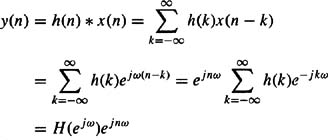
where ? is a constant, are eigenfunctions of LSI systems. This may be shown from the convolution sum:
Thus, the eigenvalue, which we denote by H( e j?), is
Note that H( e j?) is, in general, complex-valued and depends on the frequency