Schaum's Outline of Theory and Problems of Digital Signal Processing
Chapter 4: The z-Transform

4.1 INTRODUCTION

The z-transform is a useful tool in the analysis of discrete-time signals and systems and is the discrete-time counterpart of the Laplace transform for continuous-time signals and systems. The z-transform may be used to solve constant coefficient difference equations, evaluate the response of a linear time-invariant system to a given input, and design linear filters. In this chapter, we will look at the z-transform and examine how it may be used to solve a variety of different problems.

4.2 DEFINITION OF THE z-TRANSFORM

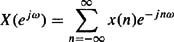
In Chap. 2, we saw that the discrete-time Fourier transform (DTFT) of a sequence x( n) is equal to the sum


However, in order for this series to converge, it is necessary that the signal be absolutely summable. Unfortunately, many of the signals that we would like to consider are not absolutely summable and, therefore, do not have a DTFT. Some examples include


The z-transform is a generalization of the DTFT that allows one to deal with such sequences and is defined as follows:

Definition: The z-transform of a discrete-time signal x( n) is defined by [1]


where z = re j ? is a complex variable. The values of z for which the sum converges define a region in the z-plane referred to as the region of convergence (ROC).

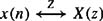
Notationally, if x( n) has a z-transform X( z), we write


The z-transform...

UNLIMITED FREE
ACCESS
TO THE WORLD'S BEST IDEAS

SUBMIT
Already a GlobalSpec user? Log in.

This is embarrasing...

An error occurred while processing the form. Please try again in a few minutes.

Customize Your GlobalSpec Experience

Category: Digital-to-Analog Converter (DAC) Chips
Finish!
Privacy Policy

This is embarrasing...

An error occurred while processing the form. Please try again in a few minutes.