Schaum's Outline of Theory and Problems of Digital Signal Processing

Chapter 8: Implementation of Discrete-Time Systems

8.1 INTRODUCTION

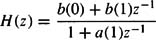
Given a linear shift-invariant system with a rational system function H( z), the input and output are related by a linear constant coefficient difference equation. For example, with a system function


the input x( n) and output y( n) are related by the linear constant coefficient difference equation


This difference equation defines a sequence of operations that are to be performed in order to implement this system. However, note that this system may also be implemented with the following pair of coupled difference equations:


With this implementation, it is only necessary to provide one memory location to store w( n ? 1), whereas Eq. (8.1) requires two memory locations, one to store y( n ? 1) and one to store x( n ? 1). This simple example illustrates that there is more than one way to implement a system and that the amount of computation and/or memory required will depend on the implementation. In addition, the implementation may affect the sensitivity of the filter to coefficient quantization, and the amount of round-off noise that appears at the output of the filter.

In this chapter, we look at a number of different ways to implement a linear shift-invariant discrete-time system and look at the effect of finite word lengths on these implementations.

8.2 DIGITAL NETWORKS

For a linear shift-invariant system with a rational system function, the input x( n) and the output y(

UNLIMITED FREE
ACCESS
TO THE WORLD'S BEST IDEAS

SUBMIT
Already a GlobalSpec user? Log in.

This is embarrasing...

An error occurred while processing the form. Please try again in a few minutes.

Customize Your GlobalSpec Experience

Category: IC Electronic Filters
Finish!
Privacy Policy

This is embarrasing...

An error occurred while processing the form. Please try again in a few minutes.