Schaum's Outline of Theory and Problems of Digital Signal Processing

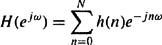
The frequency response of an Nth-order causal FIR filter is
and the design of an FIR filter involves finding the coefficients h( n) that result in a frequency response that satisfies a given set of filter specifications. FIR filters have two important advantages over IIR filters. First, they are guaranteed to be stable, even after the filter coefficients have been quantized. Second, they may be easily constrained to have (generalized) linear phase. Because FIR filters are generally designed to have linear phase, in the following we consider the design of linear phase FIR filters.
Let h d( n) be the unit sample response of an ideal frequency selective filter with linear phase,
Because h d( n) will generally be infinite in length, it is necessary to find an FIR approximation to H d( e j ?). With the window design method, the filter is designed by windowing the unit sample response,
where w( n) is a finite-length window that is equal to zero outside the interval 0 ? n ? N and is symmetric about its midpoint:
The effect of the window on the frequency response may be seen from the complex convolution theorem,
Thus, the ideal frequency response is smoothed by the discrete-time Fourier transform of the window, W( e j ?).
There are many different types of windows that may be used...