Secrets of 5-Axis Machining
Unbiased and no-nonsense, this to-the-point book demystifies 5-axis machining, and will bring it within the reach of anyone who is interested in using this technology to its full potential.
 TABLE OF CONTENTS
 Table/Table multiaxis milling machines can be vertical or horizontal. All the rotary motions except the spindle are done by the tables of these machines. The main rotary table carries a second rotary table, as shown in Figure 2-6, to which is fastened the fixture and the part to be machined.
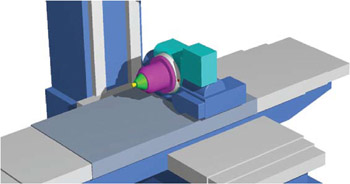
Tool length offsets work the same way here as with any conventional 3-axis machine. The tool length can be changed without the need to re-post the NC data.
On these machines, the part is physically rotated around the tool. The machine s rotary devices need to be capable of handling the weight of the part and the fixture, and this capability is an important factor when rapid movements are considered. Another variation is seen in Figure 2-7.
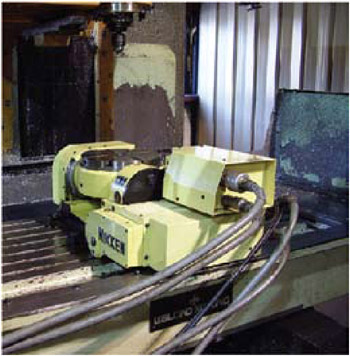
The examples shown represent only a small fraction of the available Table/Table variations. Most of these machines have minimum and maximum rotary limits on one of the rotary axes. Some will have unlimited rotary motion on the other axis. Some even have the capability to spin the work, as a lathe would.
Table/Table machines are the most common types of multiaxis machines. Most people will enter the 5-axis world by purchasing a single- or dual-rotary device and bolt it to...