Secrets of 5-Axis Machining
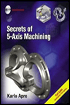
Unbiased and no-nonsense, this to-the-point book demystifies 5-axis machining, and will bring it within the reach of anyone who is interested in using this technology to its full potential.
 TABLE OF CONTENTS
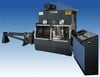
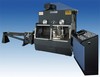
 As their name suggests, these machines have a rotary table and a tilting head.
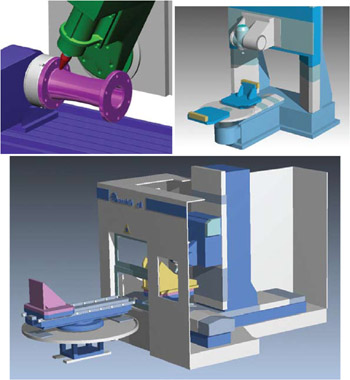
Head/Table machines are arguably the most capable of the three groups illustrated and can machine large, heavy parts. On some machines, the rotary table can be supported by a steady rest and it rotates the part only around its own axis. The pivoting spindle head carries the weight of the tool. It needs to be capable of handling the cutting pressures as it is manipulating the tool.
These machines are also well suited for both indexing and simultaneous work. Some have the capability to calculate axis substitution internally, enabling the user to program parts in the 2D flat plane and then wrap the plane around a specified fourth-axis diameter.
Axis substitution is shown in Figure 2-26, and is effected by the following procedure.
Measure the A-axis diameter and multiply it by Pi to find the circumference.
Draw a rectangle where the Y side is the circumference and the X side is the length of the part.
Create the cutting geometry inside this rectangle.
Create a 3-axis toolpath, XYZ, and activate axis substitution by first defining the A-axis diameter.

On a Bostomatic controller, for example, this result is achieved by adding two lines of...