Secrets of 5-Axis Machining
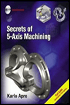
Unbiased and no-nonsense, this to-the-point book demystifies 5-axis machining, and will bring it within the reach of anyone who is interested in using this technology to its full potential.
 TABLE OF CONTENTS
 The arrangements shown in Figure 2-1 are all very popular configurations, but none of them is standard. There is no such thing as a standard 5-axis machine. First, let s establish the definition of an axis. Any motion controlled by the NC controller, either linear or rotational is considered an axis. For instance, in the illustration in Figure 2-2, both the spindle head and the quill are capable of moving in the same direction, but are controlled by two separate commands. Movements of the head are controlled by Z and those of the quill by W.

The terms multiaxis and 5-axis are often used interchangeably and these terms can be confusing. The widely recognized term in the industry is 5-axis, but it is misleading because 9-axis standard possibilities exist without adding additional sub-systems. In addition, a 4-axis machine is also considered to be a multiaxis machine. Despite the title of this book, the more accurate term multiaxis will often be used.
The following list provides the industry standard nomenclature for the basic 9-axis designations and directions.

XYZ are linear axes where Z is aligned with the spindle of the machine.
ABC are rotary axes rotating around XYZ respectively.
UVW are parallel linear axes along XYZ respectively.
Unfortunately, different machine builders abide by this standard in different ways. Some builders allow the end user to change the machine s rotational directions...