SFPE Engineering Guide: Piloted Ignition of Solid Materials Under Radiant Exposure
For a thermally thick inert solid, the solution for the surface temperature as a function of time requires a Laplace Transform that includes the complementary error function. The solution to the complementary error function must be solved numerically or found in tables. The solution can be expanded using an asymptotic series to yield the following approximation for the time to ignition. The full solution is available in reference 16. An approximate solution to the time to ignition is derived using the first term of the series expansion and substituting the ignition temperature for the surface temperature. This expression for the time to ignition is:
Where:
| k | = | thermal conductivity |
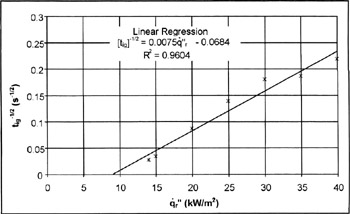
The product k ? c, referred to as the thermal inertia, is typically reported as a single quantity from ignition experiments rather than the discrete values for k, ? and c. By plotting the inverse square root of the time to ignition, t ig ?1/2, versus the radiant heat flux,
, the data typically fall along a straight line as shown in Figure 2. The data are shown as x, and the solid line is the best-fit linear regression line. Extrapolating the linear regression line for t ig ? ?, i.e.,
gives the critical heat flux (
) value as the intercept with the abscissa.
The slope of the best-fit line...