SFPE Engineering Guide: Piloted Ignition of Solid Materials Under Radiant Exposure

Originally developed by Smith and Green32 for predicting the time to ignition within a thermally closed system, i.e., the OSU apparatus, Toal, Silcock, and Shields31 recommended that the Flux Time Product ( FTP) method be extended for use on data from the cone calorimeter and the ISO ignitibility apparatus. In a separate paper Silcock and Shields33 derived the appropriate dimensionless groups for piloted ignition. They then assumed a power law expression for the dimensionless groups and derived and obtained the following expression:
Where:
| FTP n | = | flux time product |
| n | = | flux time product index ? 1 |
Equation 19 can be rearranged to solve for the ignition time, which gives the following form:
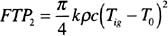
When n is equal to unity, Equation 20 is the same form as the thermally thin result in Equation 1, where FTP 1 = ? L 0 c( T ig ? T 0). Similarly, if n = 2, then Equation 20 is equivalent to the thermally thick solution given in Equation 3 where
. Likewise, when n = 1.83, Equation 20 is comparable with Janssens' Equation 17 result that used temperature-dependent thermal properties and nonlinear boundary conditions.
The value of FTP n is determined by plotting the data using the following form of Equation 19:
The value of n is then varied until the data falls along a straight line, typically 1 ? n ?2. Once the appropriate power is found by...