SFPE Engineering Guide: Piloted Ignition of Solid Materials Under Radiant Exposure

Tewarson has assembled one of the largest collections of ignition data available for engineering analysis. In his analysis, he has simplified the thermally thick relationship given in Equation 3. In this case, Tewarson has combined the ignition temperature and the thermal inertia into a single parameter he calls the Thermal Response Parameter ( TRP) defined as:
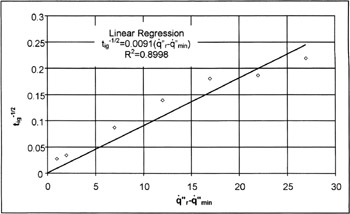
The TRP is determined experimentally from the ignition results of the Factory Mutual Research Corporation Flammability Apparatus and the cone calorimeter. However, there is no reason this procedure cannot be used for other experimental methods. For the data given by Tewarson, the samples were placed horizontally and the time to ignition was recorded for several different heat flux levels. The data are then plotted as
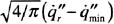
versus
as shown in Figure 3. Note that, for this technique, Tewarson uses
rather than
that was used in the thermally thick solution. The time to ignition is calculated using the simplified version of Equation 3 that incorporates the TRP:
The TRP is calculated from the slope of the linear regression line through the data using the relationship expressed in Equation 9:
For the data plotted in Figure 3, the TRP is:
The principal advantage to Tewarson's method is that the surface temperature is not required. Although the critical surface temperature is simple to understand, in practice...