Softswitch: Architecture for VoIP

Chapter 2: The Public Switched Telephone Network (PSTN)

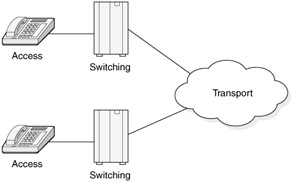
An understanding of the workings of the Public Switched Telephone Network (PSTN) is best grasped by understanding its three major components: access, switching, and transport (see Figure 2-1). Each element has evolved over the 100-plus year history of the PSTN. Access pertains to how a user accesses the network. Switching refers to how a call is "switched" or routed through the network, and transport describes how a call travels or is "transported" over the network.


Figure 2-1: The three components of a telephone network access, switching, and transport

Access

Access refers to how the user accesses the telephone network. For most users, access is gained to the network via a telephone handset. Transmission and reception is via diaphragms where the mouthpiece converts the air pressure of voice into an analog electromagnetic wave for transmission to the switch. The earpiece performs this process in reverse. The most sophisticated aspect of the handset is its Dual-Tone Multifrequency (DTMF) function, which signals the switch by tones. The handset is usually connected to the central office (where the switch is located) via copper wire known as twisted pair because, in most cases, it consists of a twisted pair of copper wire. The stretch of copper wire connects the telephone handset to the central office. Everything that runs between the subscriber and the central office is known as outside plant. Telephone equipment at the subscriber end is called customer premise equipment (CPE).

Switching

The PSTN is a star network; that...

UNLIMITED FREE
ACCESS
TO THE WORLD'S BEST IDEAS

SUBMIT
Already a GlobalSpec user? Log in.

This is embarrasing...

An error occurred while processing the form. Please try again in a few minutes.

Customize Your GlobalSpec Experience

Category: Network Modems
Finish!
Privacy Policy

This is embarrasing...

An error occurred while processing the form. Please try again in a few minutes.