Softswitch: Architecture for VoIP

Softswitch: A Smaller Footprint

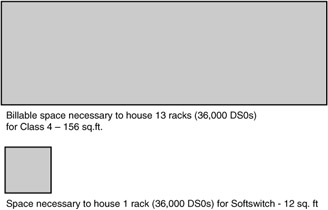
Softswitch is smaller than Class 4 and, as illustrated in Figure 11-2, requires less physical space to deliver the same port density, that is, the equivalent number of phone lines as Class 4. Depending on the configuration, a softswitch may take as little as one-thirteenth of the space required by Class 4 to perform the same service. This is an advantage for softswitch. Due to the smaller footprint, softswitch power consumption and cooling requirements are also less than the legacy switches. Smaller hardware size also translates into lower "real estate" expenses.


Figure 11-2: A comparison of space needed to house 36,000 DS0s in Class 4 and softswitch

One comparison is a softswitch solution from Convergent Networks. Their product can concentrate 36,000 DS0s in one 7-foot rack consuming a 24-inch x 24-inch space, plus space to access the switch, for a billable total of 12 square feet per month. A Class 4 switch in comparison, delivering 36,000 DS0s, requires 13 racks for a total of 156 square feet per month at $35 per square foot of central office space per month. The softswitch in this example offers a 92 percent cost saving over the Class 4 in real estate costs. [11]

The miniaturization of Class 4 components will not soon match the advantages of softswitch in footprint. The smaller footprint of the softswitch translates into lower real estate costs for the service provider. Although this may not be a major concern for an incumbent provider who has...

UNLIMITED FREE
ACCESS
TO THE WORLD'S BEST IDEAS

SUBMIT
Already a GlobalSpec user? Log in.

This is embarrasing...

An error occurred while processing the form. Please try again in a few minutes.

Customize Your GlobalSpec Experience

Category: Tablet Computers
Finish!
Privacy Policy

This is embarrasing...

An error occurred while processing the form. Please try again in a few minutes.