Statistical Mechanics of Solids

The boundary between any two phases is not sharp, but contains a transition region in which there is a continuous change in composition from one phase to the other. Of course, all the laws of thermodynamics apply to the system as a whole, and at equilibrium, the temperature, pressure, and chemical potentials are constant throughout the system. But because of the spatial variation of the densities of the components, the energy per unit volume (and other thermodynamic functions per unit volume) varies with position over a finite distance in the transition region. The total energy is therefore different than that of the sum of the energies of the two phases taken separately.
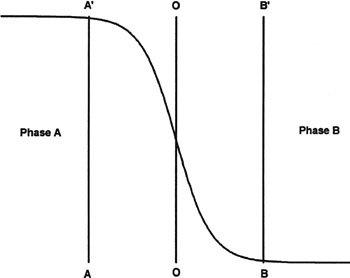
Two ways of assigning thermodynamic properties to a planar interface separating two phases were introduced by J. Willard Gibbs. In the first method, the system is divided into three parts by constructing two planar surfaces parallel to the interface, as shown in figure 12.1, which represents two phases, A and B, in contact across a planar interface in a large container. It is assumed that the system is in thermodynamic equilibrium and all external fields, including gravitation, are zero. The planes are chosen in such a way that the concentration of components varies sensibly with position only between them.
Thus, to the left of the plane AA ? the system has the properties of the bulk phase A, while to the right of plane BB ?