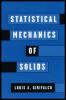
Statistical Mechanics of Solids

Chapter 2: Principles of Statistical Mechanics

2.1 Definitions for statistical mechanics

The prime article of faith in scientific theory is that experimentally observed phenomena can be derived from a small number of general principles. The acceptance of this idea implies that, despite the constant changes evident in physical systems, they possess some immutable attributes from which all of their interesting properties can be calculated. A central concept in such a calculation is that of the state of an isolated system. If all of the experimentally measurable properties of a system are known at all times, then this would certainly constitute an adequate description of the state of the system. However, such a definition would be useless for theoretical purposes and is contrary to the assumption that all properties can be related to a few general laws. The most fruitful definition of state is this:

The state of a physical system is the minimum amount of information required for a calculation of its properties.

A theory can be regarded as the set of concepts and mathematical apparatus needed to go from the definition of of the state of a system to its observable properties.

A system is defined as any physical entity that can be separated from the rest of the world, at least to a good approximation. That is, the energy of interaction of the system with the rest of the world is small compared to the system's energy. No system is truly isolated since there are always some interactions with its surroundings. In...

UNLIMITED FREE
ACCESS
TO THE WORLD'S BEST IDEAS

SUBMIT
Already a GlobalSpec user? Log in.

This is embarrasing...

An error occurred while processing the form. Please try again in a few minutes.

Customize Your GlobalSpec Experience

Category: Mesh Generators
Finish!
Privacy Policy

This is embarrasing...

An error occurred while processing the form. Please try again in a few minutes.