Lagrange's method of undetermined multipliers is used frequently in physical problems to determine maxima or minima of certain functions subject to subsidiary conditions. In this appendix, a brief description of the mathematics involved is presented without encumbering the analysis with physical applications.
We are given a function F of a number of variables y 1, y 2, , and so on:
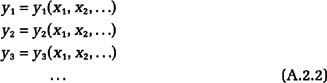
The variables are themselves functions of a set of parameters x 1, x 2, , and so on. That is,
Now we want to find the functional form of equations (A.2.2) that gives F a stationary value (makes F maximum or minimum). Throughout the search for this functional form, the xs are taken to be given and to remain constant.
If F is to be stationary, then any variation of F, resulting from a variation in the ys, must be zero. That is,
where r is the total number of ys. If the y i were all independent, each coefficient of ? y i would have to be zero because the variations ? y i are completely arbitrary. The problem would then be solved. All we need do is set each partial derivative equal to zero. We are much more interested in the case in which the y i are not completely independent, but in which some functions of the y i and the x i exist that...
Copyright Oxford University Press 2000 under license agreement with Books24x7

 TABLE OF CONTENTS