Statistical Mechanics of Solids

Chapter 13: The Theory of Random Flight

13.1 Introduction

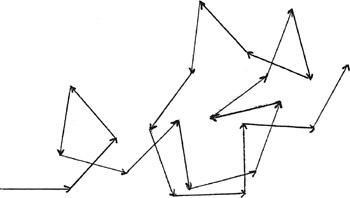
The theory of the random motion of a particle through space has a variety of uses. Two important applications are to molecular or atomic diffusion, and to the statistics of long chain molecules. To clarify the concept of random flight, consider a particle that, starting from a fixed point R o = 0, can move a distance r in any direction. After the first jump, the particle can again move in any direction, but with the same distance r. That is, the motion of the particle consists of a number of N sequential jumps in an arbitrary direction, but all having the same magnitude. The particle is said to have executed a random flight of N equal-sized steps that are defined by the set of vectors { r} N ? r 1, r 2, r 3, , r N, each having a magnitude r, after which it has moved a distance R.

Each step is called a jump, and the distance from the starting point after N jumps is called the total displacement. An example of a random flight in two dimensions is shown in figure 13.1. For a general random flight, the jump distances do not necessarily all have the same magnitude.


Figure 13.1: Two-dimensional random flight.

Two important properties of a random flight that arise in physical applications are the scalar distance R = R between the starting...

UNLIMITED FREE
ACCESS
TO THE WORLD'S BEST IDEAS

SUBMIT
Already a GlobalSpec user? Log in.

This is embarrasing...

An error occurred while processing the form. Please try again in a few minutes.

Customize Your GlobalSpec Experience

Category: Flight Management Systems
Finish!
Privacy Policy

This is embarrasing...

An error occurred while processing the form. Please try again in a few minutes.