Universal Joints and Driveshafts: Analysis, Design, Applications

Chapter 2: Theory or Constant Velocity Joints

Overview

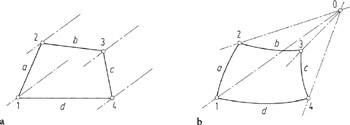
According to the principles of kinematics the universal joints of a driveshaft belong to the family of spherical crank mechanisms. They arise from the planar four-bar linkage (Fig. 2.1a) if the axes of rotation 1 to 4 are placed such that they meet at the point 0 (Fig. 2.1b). The four-bar linkage remains movable and positively actuated as before. It is called a


Fig. 2.1 a,b: The four-bar linkage. a Planar four-bar linkage, b spherical four-bar linkage

Conical or Spherical Four-bar Linkage

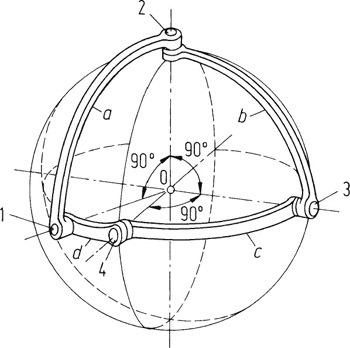
Its links a to c lie on a sphere about 0 and are parts of great circles. If three of these links are selected to be at right angles then the

Right-angled, Spherical Four-bar Linkage

occurs, or the right-angled, spherical universal joint drive (Fig. 2.2). This is an example of a kinematic chain thus named for the first time in 1875 by Franz Reuleaux [2.1; 2.2].


Fig. 2.2: Right-angled spherical Hooke's joint chain [2.13]

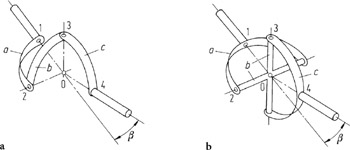
It is particularly significant for driveshafts because, by fixing link d at an angle not equal to 90 , the

Rotating Hooke's Joint

Arises (Fig. 2.3), see Sect. 1.2.1.


Fig. 2.3a, b: Development of the rotating Hooke's joint. a right-angled spherical Hooke's joint chain, b by transforming link b into a cross and fixing link d (drawn without support d)

2.1 The Origin of Constant Velocity Joints

By arranging two Hooke's joints back to back it is possible to do away with the non-uniformity...

UNLIMITED FREE
ACCESS
TO THE WORLD'S BEST IDEAS

SUBMIT
Already a GlobalSpec user? Log in.

This is embarrasing...

An error occurred while processing the form. Please try again in a few minutes.

Customize Your GlobalSpec Experience

Category: Differentials and Axles
Finish!
Privacy Policy

This is embarrasing...

An error occurred while processing the form. Please try again in a few minutes.