Universal Joints and Driveshafts: Analysis, Design, Applications

4.5: Pode Joints

4.5 Pode Joints

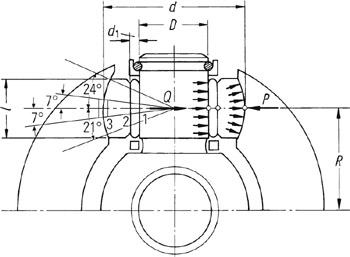
Pode joints combine elements of Hooke's and ball joints. The tangential component P x of the compressive load P, resulting from the torque M, is transmitted by the pode trunnions of the input member via spherical members with roller or plain bearings, to the output member (Fig. 4.73). If the transmitting roller has a roller bearing, line contact occurs at point 1 between the pode trunnion and the bearing needles, and also at point 2 between the bearing needles and the roller bore. If the bearing is plain point 2 is eliminated; when assessing the trunnion stress at point 1, a distinction must be made between the non-articulated and the articulated joint. For an articulated joint, the rollers turn, i.e. the sliding faces of the trunnion and bore are lubricated. Only low surface stresses can be permitted here ( p < 60 N/mm 2).


Fig. 4.73: Loads on the trunnion of a pode joint

The roller and the track are in point contact at 3; this is determined by the conformity in the cross-section. The (concave) conformity ( ? = 1.02 to 1.08).

The torque capacity of pode joints is determined by the permissible stresses at points 1 to 3. The compressive load from (4.16) is distributed at points 1 and 2 to the whole needle bearing; at point 3, the equivalent compressive load P acts on the...

UNLIMITED FREE
ACCESS
TO THE WORLD'S BEST IDEAS

SUBMIT
Already a GlobalSpec user? Log in.

This is embarrasing...

An error occurred while processing the form. Please try again in a few minutes.

Customize Your GlobalSpec Experience

Category: Needle Roller Bearings
Finish!
Privacy Policy

This is embarrasing...

An error occurred while processing the form. Please try again in a few minutes.