Videoconferencing Demystified: Making Video Services Work

This book shows you how to bring videoconferencing benefits to your business.
 TABLE OF CONTENTS
 In this section we discuss the components found in a typical end-user environment including computers and LANs. We begin with an examination of the computer. In one way or another, the computer is the ultimate technology device; it appears in one form or another in every device used by a customer to access the network, including videoconference units.
For all its complexity, the typical computer only has a small number of components, as shown in Figure 1-22: the central processing unit (CPU), main memory, secondary memory, input/output (I/O) devices, and a parallel bus that ties all the components together. It also has two types of software that make the computer useful to a human. The first is application software such as word processors, spreadsheet applications, presentation software, and MP3 encoders. The second is the operating system that manages the goings on within the computer including hardware component inventory and file location. In a sense, it is the executive assistant to the computer itself; some mainframe manufacturers refer to their operating system as the EXEC.
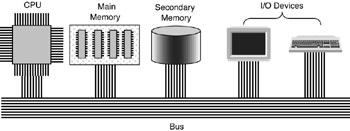
The concept of building modular computers came about in the 1940s when Hungarian-born mathematician John Von Neumann applied the work he had done in logic and game theory to the challenge of building large electronic computers (see Figure 1-23). As one of the primary contributors to the design of the Electronic Numerical Integrator and Computer (ENIAC), Von Neumann introduced the concept of stored program control and...