Videoconferencing Demystified: Making Video Services Work

This book shows you how to bring videoconferencing benefits to your business.
 TABLE OF CONTENTS
 Seven variations on conferencing will be discussed in this section. Many are technically similar so it is important to understand the functional differences between them. The services covered include videoconferencing, teleconferencing, IP conferencing/multicasting, streaming media, web conferencing, imaging, and desktop conferencing.
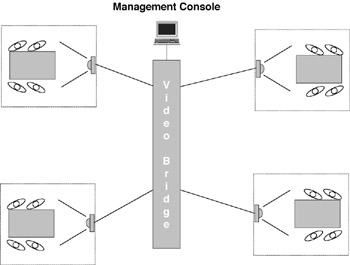
Videoconferencing takes on a variety of forms depending on the scenario at which it is targeted. Most commonly, it is used to facilitate point-to-point or point-to-multipoint meetings among individuals located far from each other. For example, a manager who has employees in three cities may want to conduct a staff meeting, but does not want to incur the costs of travel for so many people. As Figure 1-1 illustrates, each location has a videoconferencing room that houses a videoconferencing unit. The unit comprises one or two monitors (one to display the local room and the other to display whichever remote room has the floor ) and a video camera that can be adjusted to follow the movements of whichever person is talking. In some advanced units, the camera automatically follows the voice of the speaker. This type of setup enables each location to see other locations. In most cases, the system is set up in such a way that whichever site is generating the voice signal (talking) is displayed on all remote monitors. As soon as another person at a different site interrupts, the conferencing equipment automatically switches the view to that room.
Unless the conference is point...