Videoconferencing Demystified: Making Video Services Work

This book shows you how to bring videoconferencing benefits to your business.
 TABLE OF CONTENTS
 It is now time to shift gears and discuss video technologies such as source devices, transport networks, and termination devices. We begin our discussion with a high-level examination of the overall network; please see Figure 1-7.
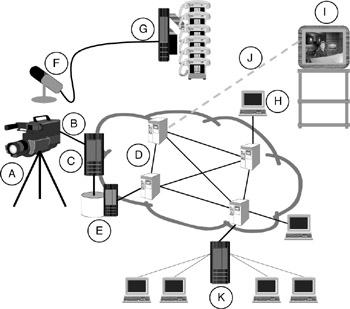
We begin with the source of the video content. A video camera (A) or videoconferencing unit captures the incoming video and audio signals and carries those signals across an access network (B) to a network switch, bridge, or server (C). The access network may be dial up, ISDN, cable, Digital Subscriber Line (DSL), wireless, or a dedicated connection. The server transmits the data, now either an uninterrupted stream of bits or a series of packets, into the transport network (D). If B is a switch, it will establish an end-to-end path between the two communicating endpoints. If it is a video bridge, it will provide the audio and video connectivity among two or more locations. If it is a server (E), it will most likely be used to stream archival content across the network to users on demand, although not necessarily live traffic can be streamed, but the delays that are inherent in streaming traffic across a public IP network are well known.
At the same time that the videoconference is taking place, the speaker s audio may be captured (F) and transmitted to a secure audio bridge (G) so that users who do not have access to a videoconference unit can still take part in the...