Videoconferencing Demystified: Making Video Services Work

This book shows you how to bring videoconferencing benefits to your business.
 TABLE OF CONTENTS
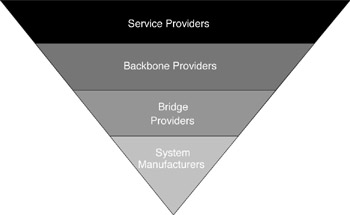
 In this section we dissect the videoconferencing industry, which comprises four major segments as shown in Figure 2-1: the system manufacturers, the bridge providers, the backbone providers, and the videoconferencing service providers.
This industry as a whole is changing as it comes to grips with its newfound importance. There was a time, for example, when audio conferencing and videoconferencing were separate and unrelated, both technologically and in terms of the applications to which they were applied. That is no longer the case. Today, combined with webcasting, web conferencing, data conferencing, and media streaming, a new breed of collaborative interaction is coming into existence. There is finally enough bandwidth in the access networks to make these multimedia applications viable. Some of them are fully interactive, some one-way only, and some hybrids of multiple technologies. Additionally, they are not all designed to be interactive in real-time. There is a growing demand for streamed content from an archival server, which viewers can download on demand. The conferencing marketplace is now comprised of a variety of innovative applications that are to a very large extent technology agnostic. Some connect using ISDN, others via the PC, and some will connect using nothing more complex than a telephone. The key is that these
technologies now adequately satisfy a broad array of customer requirements, and that, more than anything else, is driving the popularity of conferencing solutions.
One new arrival on the videoconferencing scene is the so-called Content Service Provider