Voice over 802.11

This guide for telecommunications professionals describes in detail how to engineer each component of 802.11 and VoIP for reliable, high-quality voice transmission.
 TABLE OF CONTENTS
 To properly analyze the prospects for the use of Vo802.11 (given the variants of 802.11, this book will refer to 802.11 and not specify the many variants), it is necessary to categorize where potential weaknesses or objections may occur in such a network. Would potential degradations occur in the 802.11 segment of the network or in technologies related to VoIP? If so, where and how can those degradations be minimized or eliminated? Objections would focus on those related to 802.11 and VoIP.
Detractors to IEEE 802.11 state that the technology will not achieve popular acceptance because it is limited in range, security, and QoS. As with any other technology, the market constantly strives to overcome these objections with improvements in 802.11.
The position that wireless technologies will replace the PSTN meets with a number of objections. Primarily, these objections are focused on the QoS issues, security of the wireless network, and limitations in the range of the delivery of the service.
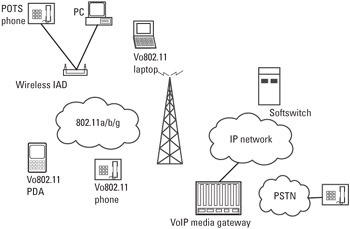
One of the primary concerns about wireless data delivery is that, like the Internet over wired services, the QoS is inadequate. Contention with other wireless services, lost packets, and atmospheric interference are recurring objections to 802.11b and associated wireless protocols as an alternative to the PSTN (Figure 5.1). QoS is also related to the ability of a service provider to accommodate voice on its network. The PSTN cannot be replaced until there is an alternative, competent replacement for voice over copper wire.