Voice over 802.11

This guide for telecommunications professionals describes in detail how to engineer each component of 802.11 and VoIP for reliable, high-quality voice transmission.
 TABLE OF CONTENTS
 There are four major classes of attack on a system by intruders: interception, fabrication, modification, and interruption [2]. A fifth class of attacks Repudiation is an attack against the accountability of information. It is an attack from within the system by either the source entity or the destination entity. Each of these classes of attack can addressed with a security mechanism (Table 7.1). Together, the security mechanisms form a cryptosystem.
| Attack | On | Solved by |
|---|---|---|
| Interception | Confidentiality and privacy | Encryption/decryption |
| Fabrication | Authenticity | Authentication |
| Modification | Integrity | |
| Replay | ||
| Reaction | ||
| Interruption | Availability | |
| Repudiation | Nonrepudiation |
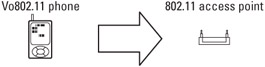
Under normal circumstances, information is sent from the source to the destination (Figure 7.1). When an attack occurs it can come in the forms listed in Table 7.1 and discussed in the following subsections.
Interception is a passive attack on confidentiality in which an intruding entity is able to read the information that is sent from the source entity to the destination entity (Figure 7.2). Sniffing is an example of an interception attack.
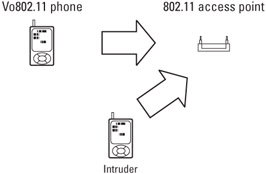
The intruder attempts to learn or make use of information from the system but does not affect system resources. The identity of the source entity can be intercepted and later used in a masquerade attack, or the intruder may be interested in releasing message contents such as authentication information, passwords, credit card numbers, intellectual property, or other sensitive information. The...