Voice over 802.11

This guide for telecommunications professionals describes in detail how to engineer each component of 802.11 and VoIP for reliable, high-quality voice transmission.
 TABLE OF CONTENTS
 If Vo802.11 is to replace legacy TDM voice networks, it must be able to scale to the same level as the network it replaces. Unlike a legacy wired network, it must take into consideration not just switching capacity, but bandwidth and spectrum allocation as well. This chapter outlines scalability concerns that network planners should take into consideration when planning a Vo802.11 application (Figure 10.1).
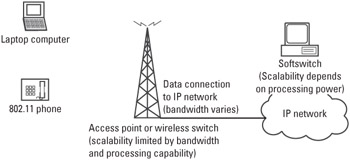
The IEEE specification for 802.11b calls for a maximum of 11 Mbps of band-width. The G.711 standard for voice traffic calls for 64 Kbps. Very simply put, this would suggest that more than 170 simultaneous G.711 conversations could take place on a single access point. However, VoIP adds considerable overhead per conversation, so the actual amount of bandwidth used in an uncompressed VoIP conversation is well in excess of 64 Kbps, depending on what information is to be included in the headers of the voice packets (could exceed 10 Kbps). Also, the use of 802.11b does not guarantee 11 Mbps of bandwidth. Rather, in the case of hotspots, for example, the source of the bandwidth is a T1 (1.54-Mbps) system ordered from the local telephone company. This would suggest more than 20 simultaneous conversations would be possible based on a 64-Kbps stream for the VoIP conversation before figuring in VoIP overhead. The use of other variants of 802.11, namely, 802.11a, which has a maximum bandwidth of 54 Mbps, would suggest, before...