Overview
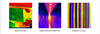
With multiresolution theory, St phane Mallat linked orthogonal wavelets with the filters used in signal processing. In this approach, the wavelet is upstaged by a new function, the scaling function, which gives a series of pictures of the signal, each at a resolution differing by a factor of two from the previous resolution. In one direction, these successive images approximate the signal with greater and greater precision, approaching the original. In the other direction, they approach zero, containing less and less information.
The wavelets still have an important role to play. They encode the difference of information between two resolutions: the details that must be added to one picture of the signal to obtain the picture at the resolution twice as great.
The idea of analyzing a picture at different resolutions was commonplace in image processing when Mallat made the connection with wavelets. Since an image generally contains structures of very different sizes, there is no single optimal resolution for analyzing them. "A multiresolution decomposition," he wrote, "enables us to have a scale-invariant interpretation of the image" [Mallat 3, p. 674]: that is, an interpretation that does not depend on the distance between the image and the "camera." With multiresolution, it's as if one brought the camera closer to capture details of the image and then moved it back to see the overall structure.
The various multiresolution decompositions that existed in image processing (Haar, cubic splines, cardinal sine ...) used a scaling function to go from one resolution to...


 TABLE OF CONTENTS