The World According to Wavelets: The Story of a Mathematical Technique in the Making, Second Edition

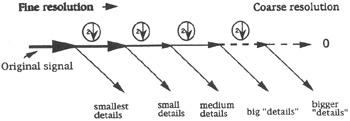
Multiresolution theory gives a simple and fast method for decomposing a signal into its components at different scales. We progressively drain the signal of its information, beginning with small details and continuing on to larger and larger components, as shown in Figure 1. At each step we encode the "details" as wavelet coefficients and work at the next step with the signal seen at half the previous resolution.
In the language of wavelets, the scaling function is dilated to make an image of the signal at half resolution; in the language of signal processing, a low-pass filter is applied to the signal, and the result is subsampled. (Flouting etymology, signal processing texts speak of "decimating" the signal by a factor of two: taking one sample out of two.)
Since at each step we take only half as many samples as before, it doesn't take long before the signal is reduced to nothing, or almost nothing. The trick is that we don't lose anything: the information encoded by the wavelets is precisely the information subtracted from the signal when we "decimate" it. We can retrace our steps and find the...