When at the age of four or five I asked my mother just how babies are made, her answer was so obviously absurd that I didn't believe her, although I knew she never lied to me. I had at times the same feeling while writing this book: statements that the experts seemed to find natural, even commonplace, seemed barely credible. What I have tried to do in this book is to make them simultaneously surprising and believable.
The project started when the executive editor of the National Academy Press asked me to write an article about wavelets for a book, A Positron Named Priscilla, on the "frontiers of science." At the time I knew nothing about Fourier analysis and had never heard of wavelets; my only mathematical qualification non-negligible was my husband, a mathematician at Cornell University. (I never took calculus in high school because I spent my senior year in Moscow, where my father was sent as a newspaper correspondent; in college I carefully avoided all math courses.)
Rashly, I agreed to the assignment, and embarked on a period of work both passionate and disconcerting, which has led me to think about the possibilities of communicating mathematical ideas. Mathematicians claim that math is not a spectator sport: you cannot understand math, or enjoy it, without doing it. A mathematician who tries to communicate his subject to the layman soon finds himself in trouble. "This is getting vaguer and vaguer," lamented Robert Strichartz of Cornell as he tried to explain function...
Copyright A K Peters, Ltd. 1998 under license agreement with Books24x7

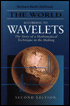
 TABLE OF CONTENTS