Ceramic Technology and Processing

Examining the difficulties of practical testing and processing in the ceramic laboratory, such as vast differences in scale and equipment, this guide shows how to evaluate results taking such variables into account.
 TABLE OF CONTENTS
Some slip properties were discussed in Chapter IV on slip preparation. This section provides additional detail on viscosity measurements. Three types of viscometers are described.
This type of viscometer usually has a rotating element submerged in the slip where the speed of rotation is controlled and the viscosity or stress is measured. Viscometers measure viscosity. Rheometers measure strain rate and shear stress where a stress/strain curve can be obtained. The principle difference is in the software and peripherals. Figure 11.19 is a picture of a common viscometer.
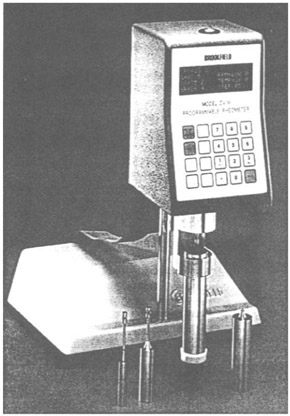
The instrument is digital, with controls for selecting shear rate and rotor speed (which is related). The spindle type is selected to put the measurements on scale. Slip temperature is also measured.
As with most modern instruments, software, a computer, printer, and accessories are available. Accessories include a spiral adapter that can be used for pastes and thixotropic materials, a helipath stand that is even better for thixotropes, temperature controls, and means to prevent evaporation of the sample. Some data taken with an instrument is shown in Figure 11.20.
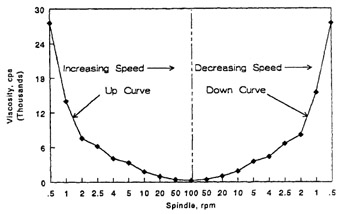
Measurements are first made by increasing the spindle rpm in increments and then decreasing it with the same settings. The data in the figure shows pronounced shear thinning where the