Ceramic Technology and Processing

Examining the difficulties of practical testing and processing in the ceramic laboratory, such as vast differences in scale and equipment, this guide shows how to evaluate results taking such variables into account.
 TABLE OF CONTENTS
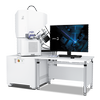
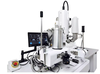
This section discusses both optical and electron microscopes. Both microscopes have their particular limitations and advantages. While there are a wide variety of optical microscopes, those usually encountered in the ceramic lab are either stereo-binocular or petrographic/metallographic. Most likely, the microscope is a universal microscope, having both transmitted and reflected light capability. The various uses of microscopy include particle size measurement, dimensions, grain size, microstructure, morphology, phase identification, stress measurement, chemical composition (electron microscopes), and crystal type identification (TEM). TEMs have also been used successfully for defect structure analysis.
They are also used to examine surfaces of fired ceramics for cracks, chips, spots, interfaces and other properties.
Many of the attributes for study are too small to be observed without magnification. But microscopes do more than just magnify, as seen in the foregoing partial list of uses.
This section describes two types of optical microscopes, stereo-binocular and universal. Many other types exist for specialized uses, and there are many other instruments that use optical microscopes as part of their design. Because the stereo-binocular and universal microscopes are most common in the ceramics lab, the discussion will be limited to these.
These are commonly used to look at the surface of ceramics and other materials where the view is similar to that produced by a magnifying glass, but at magnifications up to about 40X. Illumination is oblique; the light source illuminates the surface without going through the optics. These common microscopes are quite useful. Flexible fiber...