Circuit Analysis II with MATLAB Computing and Simulink/SimPowerSystems Modeling

In this section, we will see how the load impedance of the secondary can be reflected into the primary.
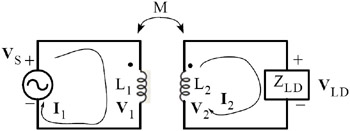
Let us consider the transformer phasor circuit of Figure 9.28. We assume that the resistance of the primary and secondary coils is negligible.
By KVL the loops equations in phasor notation are:
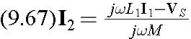
or
and
or
Equating the right sides of (9.67) and (9.69) we obtain:
Solving for V S we obtain:
and dividing V S by I 1 we obtain the input impedance Z in as
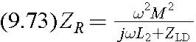
The first term on the right side of (9.72) represents the reactance of the primary. The second term is a result of the mutual coupling and it is referred to as the reflected impedance. It is denoted as Z R, i.e.,
From (9.73), we make two important observations:
The reflected impedance Z R does not depend on the dot locations on the transformer. For instance, if either dot in the transformer of the previous page is placed on the opposite terminal, the sign of the mutual term changes from M to ?M. But since Z R varies as M 2, its sign remains unchanged.
Let Z LD=R LD+jX LD. Then, we can express (9.73) as
To express (9.74) as the sum of a real and an imaginary component, we multiply both numerator and denominator by the...