Circuit Analysis II with MATLAB Computing and Simulink/SimPowerSystems Modeling

Appendix D: Review of Complex Numbers

This appendix is a review of the algebra of complex numbers. The basic operations are defined and illustrated by several examples. Applications using Euler s identities are presented, and the exponential and polar forms are discussed and illustrated with examples.

D.1 Definition of a Complex Number

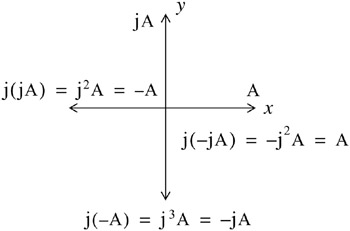
In the language of mathematics, the square root of minus one is denoted as i, that is, . In the electrical engineering field, we denote i as j to avoid confusion with current i. Essentially, j is an operator that produces a 90-degree counterclockwise rotation to any vector to which it is applied as a multiplying factor. Thus, if it is given that a vector A has the direction along the right side of the x-axis as shown in Figure D.1, multiplication of this vector by the operator j will result in a new vector j A whose magnitude remains the same, but it has been rotated counterclockwise by 90 .


Figure D.1: The j operator

Also, another multiplication of the new vector j A by j will produce another 90 counterclockwise direction. In this case, the vector A has rotated 180 and its new value now is ?A. When this vector is rotated by another 90 for a total of 270 , its value becomes j( ?A)= ?JA. A fourth 90 rotation returns the vector to its original position, and thus its value is again A.

Therefore, we conclude that j 2= ?1, j 3= ?j , and j

UNLIMITED FREE
ACCESS
TO THE WORLD'S BEST IDEAS

SUBMIT
Already a GlobalSpec user? Log in.

This is embarrasing...

An error occurred while processing the form. Please try again in a few minutes.

Customize Your GlobalSpec Experience

Category: Polarimeters
Finish!
Privacy Policy

This is embarrasing...

An error occurred while processing the form. Please try again in a few minutes.