Circuit Analysis II with MATLAB Computing and Simulink/SimPowerSystems Modeling
This chapter is an introduction to unbalanced three-phase power systems. It presents several practical examples of analysis applied to unbalanced three-phase systems and a number of observations are made based on the numerical examples. The method of symmetrical components is introduced and a phase sequence indicator serves as an illustration of a Y-connection with floating neutral
Three-phase systems deliver power in enormous amounts to single-phase loads such as lamps, heaters, air-conditioners, and small motors. It is the responsibility of the power systems engineer to distribute these loads equally among the three-phases to maintain the demand for power fairly balanced at all times. While good balance can be achieved on large power systems, individual loads on smaller systems are generally unbalanced and must be analyzed as unbalanced threephase systems.
Fortunately, many problems involving unbalanced loads can be handled as single-phase problems even though the computations can be three times as long as illustrated by the example below.
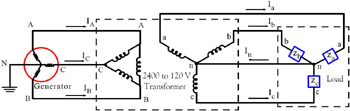
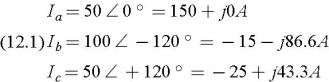
In the three-phase system in Figure 12.1, the load consisting of electric heaters, draw currents as follows:
Find the current in each phase of the Y-connected generator.
Solution:
Let us assume that these currents are balanced in phase. Then,
and the current in the neutral connection is
The currents I AB, I BC, and I CA on the primary side of each transformer is found from the known secondary currents I a, I b, and I c