Essential Rubber Formulary: Formulas for Practitioners
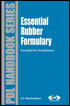
Authored by a seasoned rubber technologist of four decades, this book gives practical information on compounding techniques, coloring, ingredients, as well as typical rubber testing methods.
 TABLE OF CONTENTS
 Thin coatings are chemical resistant protective coatings used in tanks and vessels for handling food products, alcoholic beverages, and chemicals. Film formation is essential to the performance of these coatings. Solvents play an important role in the film forming process. The consistency and film thickness of the coating, as it dries, is a function of the solvent evaporation and solid content. The following formulations are based on Hypalon and neoprene rubbers.
| Ingredient | phr | |
|---|---|---|
| 100.00 | Part A |
| 2.50 | |
| 30.00 | |
| 75.00 | |
| 30.00 | |
| 0.50 | |
| 2.50 | |
| 15.00 | Part B |
| 0.25 | Part C |
| Total | 255.75 | |
| Xylene | 50.00 | |
| Toluene | 50.00 | |
| Hypalon 20 | 100.00 | |
| Note: | ||
| Specific gravity = 1.83. |
Mix part A (items 1 7) in a mixing mill and dissolve it in the solvent mixture of xylene and toluene by soaking and stirring. Then add parts B and C which are dissolved in the solvent mixture one after another. For thicker films maintain solids at 40% or increase the number of coats. Adjust the solvent level to improve brushability. Before applying, prepare the metal surface by sand blasting. Shot blasting is not preferred. Use more solvent for evaporation makeup.
| Ingredient | phr |
|---|---|
| 100.00 |
| 10.00 |
| 10.00 |
| 80.00 |
|