Power Supplies for LED Driving
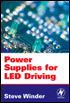
Including detailed examples of what works and why, this practical, hands-on book covers the design trade-offs involved in LED driving applications, from low-power to UB-LEDs and beyond.
 TABLE OF CONTENTS
 Most semiconductors are made by doping silicon with a material that creates free negative charge (N-type), or free positive charge (P-type). The fixed atoms have positive and negative charge, respectively. At the junction of these two materials, the free charges combine and this creates a narrow region devoid of free charge. This intrinsic region now has the positive and negative charge of the fixed atoms, which opposes any further free charge combination. In effect, there is an energy barrier created; we have a diode junction.
In order for a P-N junction to conduct, we must make the P-type material more positive than the N-type. This forces more positive charge into the P-type material and more negative charge into the N-type material. Conduction takes place when (in silicon) there is about 0.7V potential difference across the P-N junction. This potential difference gives electrons enough energy to conduct.
An LED is also made from a P-N junction, but silicon is unsuitable because the energy barrier is too low. The first LEDs were made from gallium arsenide (GaAs) and produced infrared light at about 905 nm. The reason for producing this color is the energy difference between the conduction band and the lowest energy level (valence band) in GaAs. When a voltage is applied across the LED, electrons are given enough energy to jump into the conduction band and current flows. When an electron loses energy and falls back into the low energy state (the valence band), a photon (light) is often emitted.