Power Supplies for LED Driving
Including detailed examples of what works and why, this practical, hands-on book covers the design trade-offs involved in LED driving applications, from low-power to UB-LEDs and beyond.
 TABLE OF CONTENTS
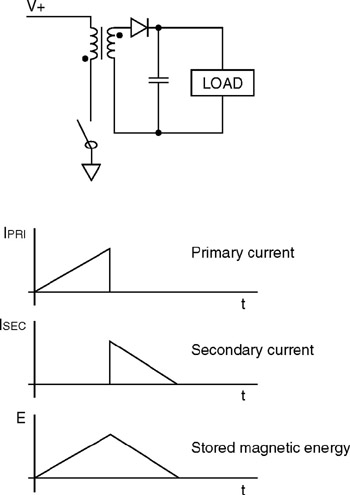
 A traditional fly-back converter uses an inductor with at least two windings (really, this is a transformer). Consider two windings; one is the primary, which is connected to the input power supply and a switch to ground; the other is the secondary, which is connected to the load. The circuit is arranged so that magnetic energy is stored in the inductor during the time that the switch is on, when current increases in the primary winding. When the switch is off, the magnetic energy is released by current flowing out of the secondary winding. This is shown in Figure 9.1.
The energy release is the fly-back , so called because in early television sets with a cathode ray tube, a transformer winding was used to deflect the electron beam back to the starting point on the screen. The electron beam had to fly back quickly after completing a scan across the screen, to avoid missing the next line of data to be displayed.
Fly-back power supplies are relatively easy to design, but are more suited to constant voltage outputs. This is because the energy is stored in bursts, in a large reservoir capacitor, and controlling the average voltage across the capacitor can be achieved with simple feedback.
Driving an isolated LED load is then possible if the secondary winding is isolated from the primary winding. Some general-purpose applications can use simple current limit techniques in the primary winding to control the output current from the secondary...