Power Supplies for LED Driving
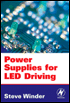
Including detailed examples of what works and why, this practical, hands-on book covers the design trade-offs involved in LED driving applications, from low-power to UB-LEDs and beyond.
 TABLE OF CONTENTS
 People sometime refer to LEDs as being a cold light source. This is true in the sense that an element is not heated to thousands of degrees Celsius in order to produce light. However, LEDs do indeed generate heat and this has been the cause of failure of several designs. As a first approximation, the heat generated is voltage drop multiplied by current flow. A white LED with a 3.5 V drop at 350mA will produce about 1.225 W of heat. Actually the emission of photons (light) will reduce this power a little, but it is better to design a larger heatsink to be on the safe side.
Power LEDs should always be mounted on a heatsink. For example, a traffic light using six or seven 1 W LEDs could be mounted alongside the driver electronics on a 6 inch diameter circular PCB. A heatsink could be mounted on the backside of the PCB for removing heat from both the LEDs and the driver circuit. Since traffic lights may have to work in high ambient temperatures, a good thermal conductivity is required; electrolytic capacitors in the driver circuit should be avoided in this case, for long-term reliability.
When designing analog or switching power sources, we discuss efficiency. This is the ratio power out/power in, and is usually expressed as a percentage. What designers sometimes overlook is that input power minus output power equals power loss in the LED driver circuit; see Figure 14.1. Loss in...