Power Supplies for LED Driving
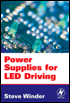
Including detailed examples of what works and why, this practical, hands-on book covers the design trade-offs involved in LED driving applications, from low-power to UB-LEDs and beyond.
 TABLE OF CONTENTS
 This chapter will examine the advantages and disadvantages of the various driver techniques, which have already been described. The issues of efficiency, EMI, cost and other requirements that are additional to the basic function of the LED driver.
In Chapter 4 we saw how the use of linear regulators caused a heat dissipation problem because of low efficiency. A linear LED driver is generally less efficient than a switching driver. Sometimes a linear driver can be more efficient. For example, if you have a 12V power source and three LEDs each having a 3.5 V forward drop, by connecting them in series the total drop is 10.5V. The efficiency of a linear driver, dropping only 1.5 V will be 87.5%. It would be difficult for a switching LED driver to achieve this level of efficiency. And there is no EMI to be filtered.
On the other hand, driving one LED from a 12V supply would give an efficiency of 3.5/12 =29% with a linear LED driver. Here a buck switcher would give closer to 90% efficiency. See Figure 10.1. Efficiency is important where heat dissipation must be minimized. Otherwise cost usually takes precedence and the cost of a switching regulator with EMI filters would be somewhat higher.
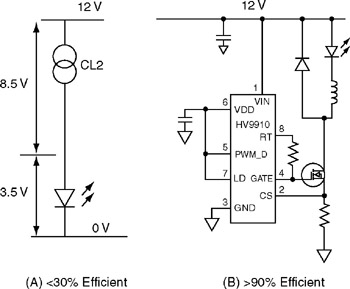
In Chapters 5 to 9 we looked at switching regulators, which have much higher efficiency, but can generate electro-magnetic interference (EMI) which has to be suppressed by careful circuit board design,...