
Split Case Pumps Injection Pumps
Last Updated: April 1, 2025
Description
Split case pumps are a type of pump designed to handle large volumes of fluid. They are characterized by a casing that is split into two separate chambers, which allows for easy access to the internal components for maintenance and inspection. These pumps are typically used to move fluids efficiently and are known for their robust construction and ability to handle high flow rates.
Working Principle
Split case pumps operate by utilizing a centrifugal force mechanism. The fluid enters the pump through the suction side and is directed towards the impeller. As the impeller rotates, it imparts kinetic energy to the fluid, increasing its velocity. The fluid is then directed into the volute casing, where the high velocity is converted into pressure energy, allowing the fluid to be discharged at a higher pressure. This principle makes split case pumps particularly useful for applications requiring high flow rates and moderate pressure increases.
Applications
Split case pumps are commonly used in a variety of applications, including water supply systems, irrigation, and industrial processes. They are particularly effective in municipal water treatment plants, where they are used to transport large volumes of water. Additionally, they are employed in HVAC systems for circulating water in cooling and heating systems, as well as in fire protection systems where reliable and high-capacity water delivery is crucial.
Advantages over other Injection Pumps
One of the primary advantages of split case pumps over other types of injection pumps is their ability to handle high flow rates with relatively low energy consumption. Their design allows for easy maintenance and inspection, reducing downtime and maintenance costs. Furthermore, split case pumps are known for their durability and long service life, making them a cost-effective choice for large-scale fluid handling applications.
Limitations
Despite their advantages, split case pumps have some limitations. They are generally not suitable for applications requiring very high pressures, as their design is optimized for high flow rates rather than high pressure. Additionally, the initial cost of split case pumps can be higher compared to other types of pumps, which may be a consideration for budget-conscious projects.
Considerations
When selecting a split case pump, it is important to consider factors such as initial costs, operating expenses, and maintenance requirements. While the initial investment may be higher, the long-term savings in energy and maintenance costs can offset this. Durability is another key consideration, as split case pumps are designed for long-term use in demanding environments. It is also important to evaluate the specific requirements of the application, such as flow rate and pressure, to ensure that the pump selected is the best fit for the intended use.
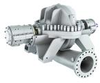
from Sulzer Ltd.
Sulzer offers a wide range of double suction axially split pumps, which includes both single and multistage designs. Each product range has special design features for targeted industry applications. Applications. Crude oil pipeline. Boiler feed boosting. Hydraulic Power Recovery Turbine (HPRT). [See More]
- Pump Type: Axial Flow Pump; Boiler Feed Pump; Centrifugal Pump; Injection Pump; Split Case Pump
- Discharge Pressure: 4152.0
- Liquid Flow: 5200.0 to 132000.0
- Discharge Size: 6.000 to 32.000