An Introduction to Nuclear Waste Immobilisation

17.9. Difficult Elements

17.9. Difficult Elements

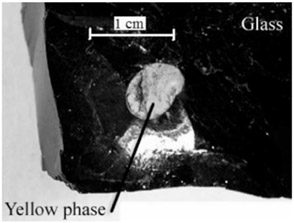
S, Cl and Mo are less glass-compatible elements. Sulphur can be incorporated in the borosilicate glass structure as up to 1 wt.% of SO 3 equivalent. Greater than 1% SO 3 causes formation of a separate water-soluble (yellow) phase. The solubility of 6-valent Mo is also very limited. During vitrification both Mo and S separate from the melt forming on its surface, a so-called yellow phase (Fig. 17.4). This phase contains alkali sulphates, alkali chromates, alkali molybdates, CaMoO 4 and Ba(Sr)CrO 4.


Figure 17.4: Yellow phase "peanut" in a British Magnox waste simulant glass. Courtesy R. Short, ISL, University of Sheffield.

F can be retained in silicate which melts by the addition of Ca to form CaF 2 giving an opacified glass. RUO 2, if present, is not soluble in the glass melt and is readily encapsulated in the form of separate particles (Fig. 17.5). Lanthanides and actinides in borosilicate glasses are microscopically immiscible, being inclined to nano-scale phase separation although the glasses remain macroscopically homogeneous. Table 17.9 gives a simplified summary of the qualitative influence of various oxides on properties of nuclear waste glasses.

Table 17.9: Qualitative influence of oxides on glass properties: plus (+) indicates an increase and minus (-) a decrease of corresponding parameter

Oxide

Property

Melting temperature

Viscosity

Density

Durability

Chemical stability

Tendency to crystallisation

SiO 2

+

+

+

+

+

+

Li 2O

-

-

+

-

-

+

K 2O

-

-

UNLIMITED FREE
ACCESS
TO THE WORLD'S BEST IDEAS

SUBMIT
Already a GlobalSpec user? Log in.

This is embarrasing...

An error occurred while processing the form. Please try again in a few minutes.

Customize Your GlobalSpec Experience

Category: Glass Powders and Precursors
Finish!
Privacy Policy

This is embarrasing...

An error occurred while processing the form. Please try again in a few minutes.