An Introduction to Nuclear Waste Immobilisation

17.2. Immobilisation Mechanisms

17.2. Immobilisation Mechanisms

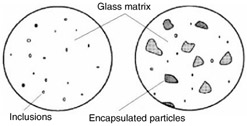
Vitrification involves melting of waste materials with glass-forming additives so that the final vitreous product incorporates the waste contaminants in its macro-and micro-structure. Hazardous waste constituents are immobilised either by direct incorporation into the glass structure or by encapsulation. In the first case, waste constituents are dissolved in the glass melt, some being included into the glass network on cooling while others are confined as modifiers. Nuclear waste glasses are not completely homogeneous vitreous materials but contain significant proportions of bubbles, foreign inclusions such as refractory oxides and other immiscible components (Fig. 17.2).


Figure 17.2: Schematic of waste retention in a glass matrix left - incorporation in a relatively homogeneous glass, with some bubbles and inclusions; right - encapsulation of waste particles in a glass matrix.

Immobilisation by encapsulation is applied to elements and compounds with a reduced solubility which cannot fit into the glass network. The solubility limits of elements as oxides in silicate glasses are given in Table 17.1.

Table 17.1: Approximate solubility limits of elements in silicate glasses

Element

Solubility limit (wt.%)

Al, Si, P, Pb

>25

Li, B, Na, Mg, K, Ca, Fe, Zn, Rb, Sr, Cs, Ba, Fr, Ra, U

15 25

Ti, Cu, F, La, Ce, Pr, Nd, Gd, Th, Bi, Zr, Pu, Th

5 15

Mn, Cr, Co, Ni, Mo

3 5

C, S, Cl, As, Se, Tc, Sn, Sb, Te, Np

1 3

H, He, N, Ne, Ar, Br, Kr, Ru, Rh, Pd, Ag, I, Xe, Pt, Au, Hg, Rn

Less than 0.1

UNLIMITED FREE
ACCESS
TO THE WORLD'S BEST IDEAS

SUBMIT
Already a GlobalSpec user? Log in.

This is embarrasing...

An error occurred while processing the form. Please try again in a few minutes.

Customize Your GlobalSpec Experience

Category: Glass Powders and Precursors
Finish!
Privacy Policy

This is embarrasing...

An error occurred while processing the form. Please try again in a few minutes.