An Introduction to Nuclear Waste Immobilisation

Phosphate glasses have been intensively studied in Russia, at the Eurochemic Corporation at Mol, Belgium, at Oak Ridge National Laboratory and the University of Missouri-Rolla in the USA. Russia has immobilised HLW from nuclear fuel reprocessing plant RT-1 in the Ural region in alumina-phosphate glass since 1987. Molten phosphate glasses are highly corrosive to refractory linings, behaviour which has limited their application. Novel Fe-Pb-phosphate glasses are particularly attractive due to their ability to accommodate enhanced amounts of refractory oxides and their high chemical durability. A number of Na-Al-phosphate, Fe-Al-phosphate and zinc phosphate compositions exhibit improved chemical durability. Fe-Pb-phosphate glasses which melt from 800 to 1000 C are not as corrosive as earlier phosphate compositions.
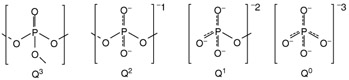
Phosphate glass structure is built around PO 4 tetrahedral units described using the Q n designation (Fig. 17.6).
In a pure P 2O 5 system, the glass is a 3-dimensional network of branching Q 3 units with three bridging oxygen atoms and one doubly bonded oxygen per tetrahedral unit. Addition of modifying alkali or alkaline earth cations replaces Q 3 units with Q 2 units with the cations creating ionic cross-links between the phosphate units. At a P 2O 5 concentration of approximately 50 mol%, the Q 3 units disappear and the structure consists of only Q 2 units in the form of linear phosphate chains. Further addition of modifying cations at concentrations greater than...